

Pressure loss in a hydraulic system sends everyone looking in the same direction: a worn part, a broken seal, or something that needs replacing. And that makes sense, because those are things you can actually get your hands on and test. Operators go through everything carefully, sometimes replace parts that look suspect, and the problem still comes back. Oil condition barely gets a look-in, and when it does, it’s usually only after everything else has been ruled out. Most hydraulic oil manufacturers will tell you this is the most consistently overlooked factor in system performance.
Temperature directly affects how hydraulic oil performs, and when the oil runs outside the range, the whole system starts to struggle. That’s where a lot of unexplained pressure loss actually starts, and why so many repairs end up fixing nothing.
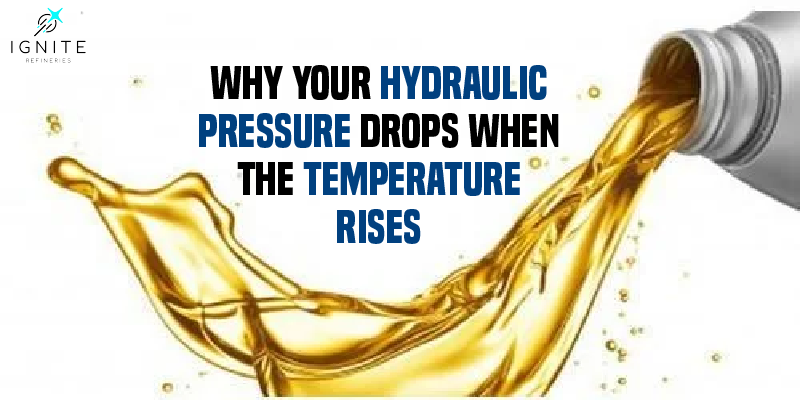
Why Does Hydraulic Pressure Drop When the Oil Temperature Increases?
Hydraulic oil acts as a connection between two points: it transfers force efficiently as long as it maintains the system under pressure. When the oil gets hot, that connection weakens. The oil thins out and starts finding shortcuts, slipping past seals and leaking back through internal clearances instead of carrying pressure where it needs to go. This is called slippage, and it’s what’s actually driving the pressure loss. The pump isn’t the problem. It’s still running, still pressurising fluid, but some of that fluid never reaches the cylinder because it takes the path of least resistance back through internal clearances. The pressure drops, output weakens, the system slows down, and nothing looks wrong from the outside.
The technical term for oil thickness is viscosity, and hydraulic systems operate within a specific viscosity range. When heat pushes the oil below that range, efficiency drops fast.
Can Poor-Quality Hydraulic Oil Cause Pressure Loss at High Temperatures?
Not all hydraulic oils handle heat the same way, and this is where oil selection matters. The Viscosity Index, or VI, measures how much an oil thins as temperature rises. High VI oils stay stable. Low VI oils thin dramatically, and in hot conditions, can fall well outside the range the system needs.
Cheaper oils tend to have lower viscosity indexes. They work fine in mild conditions, but once temperatures climb and the system starts generating its own heat, the oil thins, slippage increases, pressure drops, and the pump works harder, generating more heat. The cycle feeds on itself. The additives that keep viscosity stable also degrade under repeated thermal stress, which is why oil that performed fine last year can start causing problems if not changed on schedule.
What Are the Common Reasons for Pressure Loss in Hydraulic Systems During Summer?
Heat alone doesn’t break hydraulic systems. It’s the conditions that come with it. These are the conditions that tend to tip systems over the edge:
- Running in poorly ventilated spaces: Machine rooms or enclosures that trap heat significantly accelerate the temperature rise.
- Extended continuous operation: Long shifts without breaks give heat no chance to dissipate, and the cooling circuit can’t keep up.
- Dirty or blocked heat exchangers: If the cooler is dusty, it simply cannot cool anything down properly, and the oil just keeps getting hotter.
- Low reservoir levels: The reservoir acts as a heat sink; less oil means less thermal mass and faster temperature rise.
- Wrong viscosity grade for the climate: An oil that was correct for winter operating temperatures may be too light for summer conditions in a hot region.
Read Next: European Specs vs Indian Dust: Why Standard Oil Fails in Eastern India
How Do Hydraulic Oil Manufacturers Ensure Performance in Extreme Heat Conditions?
This is where the right oil earns its place. The hydraulic oil manufacturers in India who get this right are the ones designing around what equipment actually faces, not what a controlled test environment looks like. The areas they focus on:
- Viscosity Index: A high VI oil holds its thickness across a wide temperature range, keeping the oil within the effective operating window even as system temperatures climb.
- Oxidation resistance: Heat accelerates oxidation, breaking down the oil and depleting additives. Quality oils carry antioxidant packages that slow this process and extend useful life under thermal stress.
- Thermal stability: At high temperatures, the oil’s molecular structure can begin to break down, not just its viscosity. Synthetic and semi-synthetic base oils tend to hold together better than conventional mineral oils when this happens.
- Seal compatibility: Hot oil can attack seal materials if the chemistry is wrong. A properly formulated oil will protect seals rather than degrade them, which matters because failing seals are a direct route to pressure loss.
What Happens Inside the System When Oil Gets Too Hot?
Heat-related pressure loss builds gradually, not all at once. By the time slippage sets in, other problems are already developing alongside it. Pushing harder to compensate only adds more heat to a system that’s already struggling, and the oil gets thinner still. Seals start to break, internal clearances allow bypass flow, and the heat exchanger struggles to keep up. The oil oxidises, leaving varnish deposits on valve components that affect response. None of it is sudden. By the time the operator notices the system feeling sluggish or pressure readings dropping, several of these problems are already compounding.
Wrapping Up
Hydraulic pressure loss in summer is predictable and mostly preventable. The oil thins too much, breaks down too fast, or was never the right grade for the conditions. The fix usually comes down to three things: the right oil, changed on schedule, with a cooling system that is looked after. Ignite Refineries is one of the top hydraulic oil manufacturers in Odisha, formulating hydraulic oils specifically for the heat and humidity conditions that equipment faces across the region. If pressure stability is a recurring problem through the warmer months, getting the oil specification right is the place to start. Reach out to find the right grade.
Frequently Asked Questions
- Can I use the same hydraulic oil in summer that I used in winter?
Not always, an oil that worked fine in cooler months may be too light for summer operating temperatures and cause pressure loss.
- How often should hydraulic oil be changed in hot climates?
More frequently than the standard interval, heat accelerates oxidation and additive depletion, so the oil degrades faster than the label suggests.
- How do I know if my hydraulic oil is causing the pressure drop and not a mechanical fault?
If checks on the pump, seals, and components come back clean, the oil grade and condition should be the next thing reviewed, not the last.