



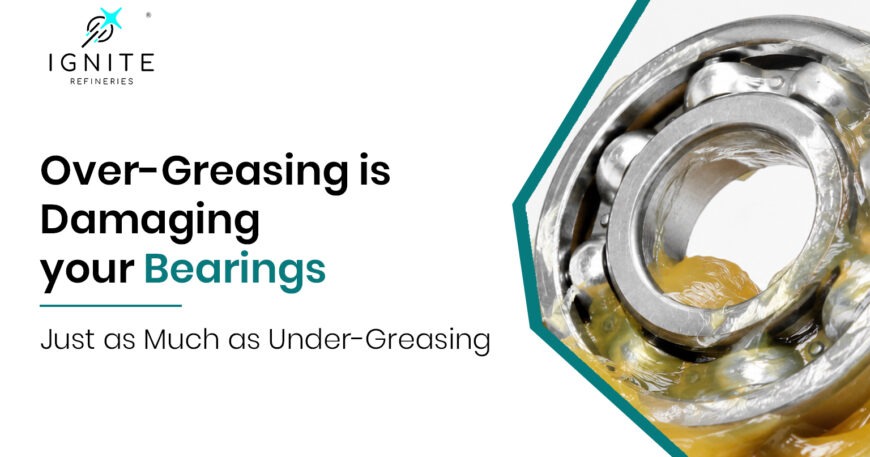
More grease, more protection. Sounds right, doesn’t it? Most maintenance teams think so, too. The problem is, over-greasing causes just as many bearing failures as running a machine completely dry. Under-greasing starves the bearing. Over-greasing chokes it. Both lead to the same outcome. It is a silent, costly mistake that catches factories off guard every year. If you work with heavy equipment, the right industrial grease manufacturer in Odisha can help you get it right before it leads to an expensive breakdown.
Table of Contents
- Why Does Over-Greasing Happen in the First Place?
- What Actually Happens When You Over-Grease a Bearing?
- Can Too Much Grease Damage Industrial Bearings and Machinery?
- What Are the Signs of Over-Greasing in Heavy Equipment?
- How Much Grease Is Actually the Right Amount?
- How Does a High-Performance Industrial Grease Supplier in Odisha Help Improve Machine Life?
- Which Grease Works Best for Long-Lasting Industrial and Automotive Machine Performance?
- Why Do Industries Choose a Top Grease Manufacturer in Odisha, India, for Lubrication Solutions?
Why Does Over-Greasing Happen in the First Place?
Over-greasing usually happens because people assume more grease means fewer problems. It sounds reasonable, and that is exactly why it keeps happening:
- More grease feels like more protection, especially when a machine is about to run for a long stretch.
- When maintenance is overdue, teams tend to compensate by adding extra lubricant to cover the gap.
- Without a calibrated grease gun, every pump stroke delivers a different amount, and nobody notices.
- In many cases, nobody on the team has ever been told what the right quantity actually is.
This is a training and systems problem. Even the best grease, sourced from a top grease manufacturer in Odisha, India, for reliable industrial lubrication, will cause damage if the person applying it does not know when to stop.
What Actually Happens When You Over-Grease a Bearing?
A bearing works best when grease is present in just the right quantity. Not generous, not topped up for good measure, just right. The rolling elements churn through the excess on every rotation, producing heat that the bearing was never meant to handle. That heat degrades the grease, the oil separates from the thickener, and what is left behind hardens and blocks lubrication passages instead of clearing them.
Can Too Much Grease Damage Industrial Bearings and Machinery?
Yes. The problem is that it does not happen all at once, so it is easy to miss until it is too late:
- Seal damage: Excessive grease increases pressure inside the housing. That pressure finds the weakest point, which is usually the seal, and once it goes, contaminants pour in.
- Excess heat: Surplus grease forces the rolling elements to churn rather than spin, which generates heat that accelerates wear.
- Blocked lubrication channels: Hardened residue settles in passages where fresh grease should flow, cutting off protection to the parts that need it most.
- Wasted energy: The machine ends up working harder than it needs to, and that shows up in your electricity bills.
- Contamination from failed seals: Once a seal fails, the bearing cavity is exposed. Water and debris in that space will cause failure faster than almost anything else.
What Are the Signs of Over-Greasing in Heavy Equipment?
The machine usually signals something is wrong before anything breaks. Here is what to watch for:
- Bearings are running noticeably warmer than usual during operation.
- Grease is visibly leaking from seals and housings.
- Bearing assemblies are making an unusual humming or rumbling noise.
- Discoloured, chunky or burnt-smelling grease when inspected.
- Increased resistance when rotating components by hand during shutdown checks.
Check Out: Metal on Metal: Why Standard Grease Fails Under Shock Loads
How Much Grease Is Actually the Right Amount?
Honestly, most teams just estimate. A pump or two, maybe three if the bearing feels dry. The problem is that guessing is exactly how over-greasing starts. There is a simple formula you can use:
If your bearing dimensions are in inches:
Grease quantity (oz) = Bearing OD (inches) × Bearing width (inches) × 0.114
If your bearing dimensions are in millimetres (more common in India):
Grease quantity (grams) = Bearing OD (mm) × Bearing width (mm) × 0.005
So, for a bearing with an outer diameter of 80 mm and a width of 18 mm, the calculation looks like this:
80 × 18 = 1440, then 1440 × 0.005 = 7.2 grams
That is all it needs. Not half a tube, not pump after pump until it feels right. Just enough grease to do its job properly.
Getting this right every time is harder without the right support. A high-performance industrial grease supplier in Odisha for long-lasting machinery protection will not just sell you grease. They will make sure your team actually knows how to apply it correctly.
How Does a High-Performance Industrial Grease Supplier in Odisha Help Improve Machine Life?
The right supplier does not just hand over a product and walk away. They look at what your machines are doing, where they are running, and what conditions they are up against. Operating conditions across Odisha vary a lot. What works near the coast will not necessarily hold up in a dry, dusty mining zone. A supplier who knows this and advises accordingly is the one actually helping you protect your machines.
Across industrial zones, choosing a leading industrial grease manufacturer in Odisha, India, for heavy equipment means you are not stuck with a supplier who does not understand what your machines are actually up against.
Which Grease Works Best for Long-Lasting Industrial and Automotive Machine Performance?
The right grease for most industrial bearing applications will have:
- The correct NLGI consistency grade for the operating speed and load.
- A base oil viscosity matched to the temperature range of the application.
- Good water resistance for equipment operating outdoors or in humid conditions.
- Compatibility with whatever grease is already in the system, since mixing incompatible greases can cause the whole thing to break down rapidly.
A durable industrial grease manufacturer in Odisha for manufacturing and automotive industries will help you match grease specifications to actual machine requirements.
Why Do Industries Choose a Top Grease Manufacturer in Odisha, India, for Lubrication Solutions?
When a machine goes down, every hour of downtime has a cost. Waiting days for a lubricant delivery from a faraway supplier is not a practical option for most plants. A local manufacturer can ship faster, knows the conditions your machines run in, and has a reputation to protect in the same market you operate in. That combination of speed, knowledge, and reliability is what keeps plants coming back to local suppliers. As the best industrial grease company in Odisha, India, for efficient machine performance, Ignite Refineries offers the dependability you need.
The Bottom Line
At the end of the day, grease is only doing its job when the right amount reaches the right place at the right time. Too little and the bearing runs dry. Too much and it works against itself. If your maintenance team is still relying on gut feel, it might be worth revisiting that approach before it results in an unplanned stoppage. Ignite Refineries, a trusted industrial grease manufacturer in Odisha, works with plants across the region to get lubrication right. Contact us and let us assess what your equipment actually needs.
Coming up next, which grease actually survives the monsoon season: calcium or lithium?
Frequently Asked Questions
- What is over-greasing?
Over-greasing happens when too much grease is applied, leading to increased friction, heat buildup, seal damage, and reduced machine performance.
- What happens if I grease the bearing too much?
Excess grease forces bearings to churn through the surplus, generating heat and pressure that deform seals and block lubrication pathways, ultimately causing premature bearing failure.
- How do I prevent applying too much grease?
Follow manufacturer guidelines on grease type, quantity, and intervals; use a calibrated grease gun; stop immediately if resistance builds during application; and consider automatic lubrication systems for consistent and precise delivery.