

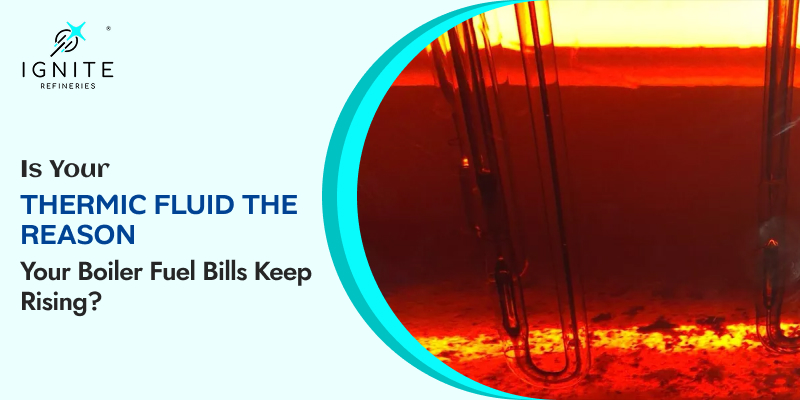
A heater running on degraded thermic fluid does not break down or trigger alarms. It just consumes more fuel than it should, gradually, every single day. The fluid thickens, oxidises, and leaves carbon deposits on the coils that restrict heat transfer and force the burner to compensate. The signs are easy to miss, and most facilities do not catch them until the losses have already added up.
Luckily, most of that loss is preventable, and it starts with sourcing the right grade of thermic fluid oil from reliable manufacturers in Odisha.
Table of Contents
- Why is Heat Transfer Oil Affecting Boiler Fuel Efficiency Over Time?
- Can Poor-Quality Thermic Fluid Oil Be the Reason Behind Rising Fuel Bills?
- What Are the Warning Signs That Your Heat Transfer Oil Needs Replacement?
- Does Degraded Thermic Fluid Oil Make Boilers Consume More Fuel?
- How Do Thermic Fluid Oil Manufacturers in Odisha Ensure Better Fuel Performance?
Why is Heat Transfer Oil Affecting Boiler Fuel Efficiency Over Time?
Thermic fluid breaks down for one simple reason: it works under sustained heat, often for hours at a stretch, day after day. At high temperatures, the hydrocarbon chains in the fluid begin to crack, causing lighter fractions to vaporise off while heavier ones remain and gradually thicken the fluid. Oxidation accelerates this process, and whenever the fluid comes into contact with air through leaks or an improperly sealed expansion tank, it degrades faster than heat alone would cause.
Continuous circulation intensifies the problem because the fluid repeatedly passes through the same coils, picking up heat and releasing it, with each cycle increasing the cumulative stress on the fluid. The deposits settle on coil surfaces slowly enough that most facilities do not notice until the fuel bills have already been reflecting the problem for months.
Can Poor-Quality Thermic Fluid Oil Be the Reason Behind Rising Fuel Bills?
Fluid quality is not something most facilities factor into their fuel costs. Over the long run, it probably should be. Lower-grade thermic fluid breaks down faster under thermal stress, forming volatile components that cause pressure instability and strain the circulation pump. As the fluid thickens with degradation, the pump works harder just to maintain circulation, adding to the fuel burden.
The grade and formulation chosen from the outset determine how quickly these problems develop. Fluids with strong thermal stability and oxidation resistance hold their properties longer, deposit less carbon, and maintain efficient heat transfer across a longer service life. For facilities in eastern India, that sourcing decision is worth getting right the first time.
Read On: Saving Your Gearbox from Eating Itself: A Guide to Micro-Pitting
What Are the Warning Signs That Your Heat Transfer Oil Needs Replacement?
Degraded fluid rarely fails dramatically. It sends quieter signals that are easy to dismiss individually, but together point to a system that is steadily losing efficiency. The following indicators need immediate attention:
- Process heating cycles are taking noticeably longer to reach target temperatures.
- Flue gas temperatures are rising, suggesting that heat is escaping through the stack rather than transferring into the process.
- Maintenance inspections are revealing sludge, dark residue, or carbon deposits inside the system.
- Pressure readings are fluctuating or triggering alarms more frequently than before.
- The circulation pump is drawing a higher current or running louder than its baseline.
Does Degraded Thermic Fluid Oil Make Boilers Consume More Fuel?
It does, and it is not hard to see why. When deposits coat the heater coils, heat does not transfer as easily, and the burner has to run longer to hit the same process temperatures. Over weeks and months, that extra runtime shows up clearly on the fuel bill. Dirty coils and degraded fluid are usually part of the same problem. Cleaning the coils without replacing the fluid, or replacing the fluid without cleaning the coils, only goes so far. Getting consumption back down means dealing with both. Here are some steps that make a real difference:
- Testing thermic fluid at least annually for total acid number, viscosity, and flash point, which are the three primary indicators of fluid health.
- Scheduling regular coil cleaning to clear carbon deposits before they develop into significant insulation layers.
- Inspecting pipeline and tank insulation for damage or gaps that allow heat to dissipate passively throughout the day.
- Monitoring flue gas temperature as a routine operational check, since a rising trend reliably signals heat loss upstream.
- Applying nitrogen blanketing on the expansion tank to reduce oxidation is one of the principal mechanisms of fluid degradation in service.
How Do Thermic Fluid Oil Manufacturers in Odisha Ensure Better Fuel Performance?
Not all thermic fluids perform the same way, and the difference comes down to formulation. Fluids made with high-quality base oils and the right additives oxidise more slowly, resist thickening at high temperatures, and leave fewer deposits on coil surfaces over time.
The better manufacturers also provide data sheets with clear numbers on when a fluid should be tested and when it needs replacing. Flash point is one of the key figures to track. A drop in flash point means light-end cracking has started, and the fluid is changing in ways that will affect system performance if left unaddressed.
For facilities where fuel efficiency and reliability matter, the sourcing decision is worth more attention than it typically gets.
Conclusion
Most cases of rising fuel consumption in thermic fluid heaters come down to the same few causes: degraded fluid, carbon-coated coils, and maintenance that has not kept pace. None of these is difficult to address once they are identified.
For facilities in the region, sourcing from the right thermic fluid oil manufacturers in Odisha is a practical place to start. Ignite Refineries’ MACHFLO™ Thermix range is built for high-temperature closed-loop systems and formulated to resist the oxidation and thermal breakdown that drives up running costs. Reach out to find the right grade for your operating conditions.
Frequently Asked Questions
- How often should thermic fluid be tested?
At a minimum, once a year, though systems running continuously or at higher temperatures benefit from testing every six months.
- Can degraded thermic fluid damage the circulation pump?
Yes, thickened fluid puts more load on the pump over time, which increases wear and can shorten its working life considerably.
- Does the volume of fluid in a system affect how quickly it degrades?
Smaller fluid volumes cycle through the heater more frequently, so they accumulate thermal stress faster and tend to degrade sooner than larger systems operating at the same temperature.