

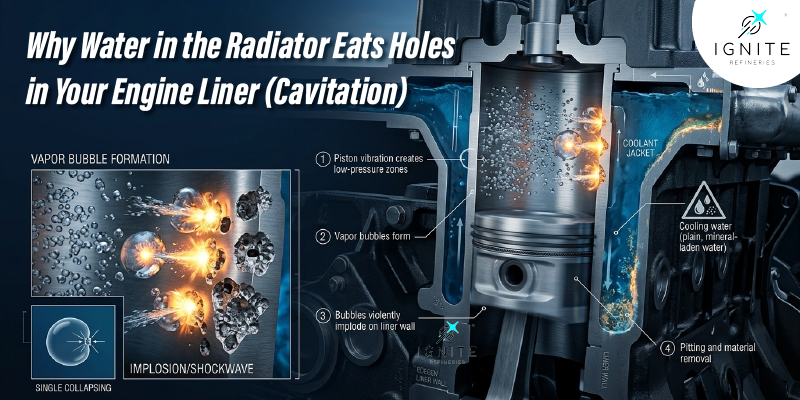
Liner cavitation is not a theory or a law. When water leaks in, you must be losing your head in a big way as a fleet manager of some kind of truck, genset, tippers or heavy equipment. Unlike the holes in your teeth caused by your incessant habit of eating sweets, the water in the heavy engine liner creates a pit on the core liner surface, allowing only coolant to reach a combustion state and thus leading to cavitation.
What are the outcomes perceived?
Downtime, white smoke, and oil spillage are particularly noticeable factors.
Hold Up: What are the steps taken by engine oil manufacturers in India to stop liner cavitation?
Pause a little before returning yet again to your initial state of panic. We at Ignite Refineries are the leading engine oil manufacturers in India. We neither blend the base oil nor sell it. We aim to develop formulas to reduce vibration load, soot loading, and thermal breakdown of fleets, which have an indirect effect on cavitation.
The Actions of the Responsible Manufacturers
- High TBN Formulations
- Manufacturers use alkalinity to counteract the acids produced during combustion.
- Advanced Additive Packages
Application of anti-wear, anti-foam, and dispersant additives, which:
- Control soot thickening
- Reduce metal surface stress
- Prevent sludge formation
- Thermal Stability Testing
- Oils are used in heavy-duty engines to ensure liner security during high-load cycles.
OEM Specification Compliance:
- Having standards such as API CI-4, CK-4 and OEM specifications
- Field Tests using Fleet Operators
- Real-world testing is conducted with reputable suppliers on the long route and in mining activities prior to commercial deployment.
Noticeable Factor: It is not an engine oil that prevents cavitation; it is a coolant. Using poor engine oil increases vibration frequency, soot loading, and combustion pressure fluctuations, all of which hasten liner wear.
Refrigerant: What is the requirement for a special coolant?
Pure water and an effective coolant go hand in hand. A heavy-diesel engine requires special coolants. There is a special heavy-duty coolant that contains:
- Organic Acid Technology (OAT) Inhibitors or nitrite
These create a coating on the liner surface.
- Anti-Foaming Agents
Avoid the formation of bubbles inside the cooling system.
- Corrosion Inhibitors
Guard cast iron, aluminium, and copper.
- Scale Control Additives
Ensures efficient heat transfer.
For fleet operators, there is no room for debate when it comes to the use of demineralised water and an approved coolant concentrate. In the absence of it, cavitation damage may commence in heavy trucks.
Why are engine oil manufacturers in Odisha hired for fleet operations?
In Odisha, particularly in mining belts and transport corridors, fleets operate under overloading conditions, with high ambient temperatures, dusty environments, and even long periods of idling. The local engine oil manufacturers in Odisha are usually for hiring purpose due to the reason that they:
- Offer Customised Blends
Regional-based fuel quality and load formulations.
- Offer Bulk Supply Contracts
Direct-to-fleet tanker supply reduces procurement costs.
- Offer Technical Support
On-site oil and on-site preventive maintenance systems.
Expensive versus Cheap Oil: What is the impact of cheap oil?
Are you looking for inexpensive engine oil options? Well, that comes with a price. Let’s have a look to get an in-depth understanding:
Cheap Oil Utilisation and its Impacts
- Additive Quality
Reduced concentrations of dispersant – soot thickening – unstable combustion.
- Base Oil Quality
Lack of oxidation strength – sludge – thermogenesis.
- Foam Control
Foaming enhances air entrainment, which reduces vibration-induced stresses.
- Viscosity Stability
Deterioration under load intensifies hammering of the metal in the cylinder.
The result?
- Higher combustion shock
- Increased liner vibration
- Faster cavitation erosion
Cheap engine oil may save money. However, replacing a liner is expensive in the lakhs. We at Ignite Refineries offer the right strategy: integrating the right engine oil that delivers efficiency while adding value. The battle is never between cheap and expensive, but rather about choosing the right, and we, as the engine oil manufacturers in Odisha, offer you the best choice.
Correct Choice: How to choose the right engine oil to stop the liner failure?
If you are in a dilemma and want to choose the right engine oil to bring a halt to the failure of the liner, here are the following checklists which you can consider:
Match OEM Recommendation
Use the engine manual to determine the grade and API rating.
Check TBN Level
High TBN is preferable to high-sulphur fuel areas.
Ask for Field Data
Seek similar fleet performance reports.
Carry out Used Oil Analysis (UOA)
Measuring iron, copper, viscosity and coolant contamination.
Avoid Mixed Brands
Fleet consistency improves efficiency by avoiding mixed brands.
Moreover, ISO certifications and testing laboratories are to align the oil with the respective coolant strategy. The oil and coolant must constitute a single protection system.
Conclusion
Liner cavitation is not a coolant-only problem. It’s a systems issue. The condition is due to un-inhibited water in the radiator. Likewise, low-grade oil increases the risk of combustion instability and intensifies the damage. Thus, if you are looking for choices that fit, connect with us. We believe in providing the best, so your liner stays free of cavities and water damage.
FAQs
Will only engine oil prevent liner cavitation?
No. Coolant inhibitors directly prevent cavitation. Engine oil is not the major barrier, but it aids in stabilising the combustion.
Can rust inhibit water sufficiently?
No. Nitrate or OAT-based prospect acts as a heavy coolant and performs efficiently if sufficient.
Is high-priced oil necessarily superior?
Not necessarily. It is the right oil that conforms to OEM specs that has good additive chemistry, and not price alone.